Showing posts with label Audi. Show all posts

Audi A3 1997 Repair Manual

Manufacturer: Audi
Model: A3
Year: 1997

Contains the following information and repairs for:

  • Electrical
    • Starter
    • Current Supply
    • Windscreen Wiper and Wash System
    • Lights, Lamps, Switches - Interior
    • Lights, Lamps, Switches - Exterior
    • Wiring 
  • Interior Equipment
  • Passenger Protection
  • Trim/Insulation
  • Seat Frames
  • Seats - Upholstery, Covers
  • Maintenance

Audi 100LS 1977 Brake Repair Guide

DESCRIPTION
Brake system is hydraulically operated, utilizing a tandem master cylinder and power brake unit. Front disc brakes consist of rotors attached to wheel hub and drive shaft and two piston calipers attached to strut assembly. Disc pads are equipped with a ceramic transmitter-type wear sensor. Transmitter is mounted on cross spring and will break when contact is made with pad plates, interrupting control circuit and causing indicator light on instrument panel to be activated. All models are equipped with pressure regulator that is mounted to body and operated by a spring connected to rear axle. Rear brakes are leading-trailing shoe/drum type, using a dual piston wheel cylinder. Parking brake is cable actuated, operating secondary shoes of rear brake assemblies.
ADJUSTMENT
NOTE - Adjustments or readjustments should be carried out on cold brakes. However, brakes must be warm when testing. Instrument panel trim must be removed to adjust master cylinder push rod free play.
MASTER CYLINDER PUSH ROD FREE PLAY
Adjustment of piston rod play at master cylinder is made by loosening lock nut and turning piston rod until correct free play, measured at brake pedal, is obtained. When correct free play of .039" is obtained between push rod and piston, free play is measured at brake pedal will be approximately .2".
FRONT DISC BRAKES
Front disc brakes are self-adjusting, therefore, no adjustment in service is required.
REAR DRUM BRAKES
Raise and support rear of vehicle and release parking brake. Using a 17 mm wrench, tighten eccentric adjusters until wheels can no longer be turned by hand. Loosen eccentric adjusters until wheels are just fee to turn.
PARKING BRAKE
NOTE - Because of the residual pressure in brake regulator, the right rear brake shoes might not fully release from drum. Before adjustment, move lever on pressure regulator rearward.
Raise and support rear of vehicle and adjust rear brakes. Lift parking brake lever until it engages third ratchet stop. Adjust nut at equalizer until rear wheels are just free to turn. When parking brake lever is pulled up one additional notch (to fourth ratchet stop), rear wheels should be locked.
BRAKE PRESSURE REGULATOR
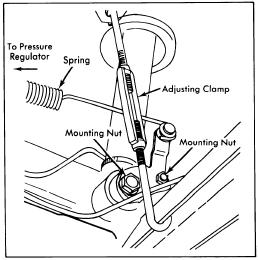
Fig. 1 Brake Pressure Regulator Adjustment Points
Checking & Adjusting - 1) Rock vehicle back and forth several times, then measure distance from top of rim to bottom of fender lip. Measurement must be made with trunk empty, gas tank full, and driver in vehicle
2) Raise vehicle on a hoist and make measurement again. If there is a difference in measurements, adjust by turning clamps. See Fig. 1.
3) Connect pressure gauges to left front and right rear wheels. Bleed pressure gauges. Apply pressure to foot pedal and note reading at gauge. Repeat procedure on right and left rear wheels.
                        Brake Pressure Values
Application                                    Pressure (psi)
Left Front.............................................  700
Right Rear............................................. 475-625
Right Front............................................ 1400
Left Rear............................................... 765-945
NOTE - DO NOT adjust brake pressure regulator when pressure is applied to brake pedal.
4) If pressure at rear wheels is to high, release spring and move spring support arm forward. If pressure at rear wheels is too low, move support arm rearward.
HYDRAULIC SYSTEM BLEEDING
Fill master cylinder reservoir with brake fluid and maintain level throughout bleeding operation. Attach a hose to bleeder screw, and immerse opposite end in a container partially full of brake fluid. Open bleeder screw, approximately one-half turn, depress brake pedal, close bleeder screw, and slowly return pedal. Continue operation until air bubbles are no longer seen in discharged fluid. Bleeding sequence is left-rear, right-rear, right-front, left-front.
REMOVAL & INSTALLATION
FRONT DISC BRAKE PADS
Removal - Remove lock clips. Pull out retaining pins so they project into openings in side members. NOTE - Do not remove rubber grammets from side member holes. Using a suitable extractor tool (SB-3), remove disc pads from caliper.
NOTE - Disc pads can be removed on right side only after removing front exhaust pipe.
Installation - Press both pistons into caliper bores.
NOTE - Fluid level in master cylinder reservoir will rise. Siphon sufficient fluid to prevent reservoir from overflowing. Ensure pistons are in correct alignment in bores using suitable tool (B-5). Install disc pads in recesses of caliper, slide in retaining pins, and install lock clip. Pump brake pedal several times to position disc pads. Bleed hydraulic system if necessary.
Fig. 2 Audi 100LS Rear Brake Assembly
FRONT DISC BRAKE CALIPER
Removal - With wheel and tire removed, take out disc pads. Disconnect hydraulic line from caliper. Remove bolts securing caliper and take off caliper.
Installation - To install brake caliper, reverse removal procedure and bleed hydraulic system
FRONT DISC BRAKE ROTOR
Removal - With wheel and tire assembly removed, take off caliper. Do not disconnect hydraulic line unless necessary. Remove screw retaining rotor to wheel hub (if equipped) and withdraw rotor.
Installation - To install rotor assembly, reverse removal procedure and bleed hydraulic system.
REAR BRAKE DRUM
Removal - Raise and support vehicle, remove wheel and tire assembly. Pry off dust cap, remove cotter pin from hex nut, and remove nut. Remove brake drum making sure that retaining washer and wheel bearing do not fall out.
Installation - To install, reverse removal procedure, adjust brakes, and adjust wheel bearings. See Wheel Bearing Adjustment in WHEEL ALIGNMENT Section.
REAR BRAKE SHOES
Removal - With brake drum removed, remove retaining spring for brake shoes. Remove shoes as an assembly by disconnecting spring at bottom, pulling shoes back from wheel cylinder, and disconnecting parking brake cable.
Installation - To install, reverse removal procedure and note the following: Make sure long ends of retaining clip and spring are installed on secondary shoe and parking brake lever. Ensure brake shoes are correctly  positioned on wheel cylinder pistons.
REAR BRAKE WHEEL CYLINDER
Removal - With drum and shoes removed, depress pedal approximately 1.2" and hold in position using a suitable pedal support. Disconnect hydraulic line from rear of backing plate and plug line to prevent loss of fluid. Remove retaining screws and wheel cylinder.
Installation - To install, reverse removal procedure, adjust brakes and bleed hydraulic system.
MASTER CYLINDER
Removal - Disconnect hydraulic line at rear of master cylinder. Depress brake pedal 1.2-1.6" and hold in position using a suitable pedal support. Disconnect remaining hydraulic line and cylinder mounting nuts. Separate master cylinder from power unit taking care not to lose "O" ring installed betweend them.
Installation - To install, reverse removal procedure and bleed hydraulic system.
POWER BRAKE UNIT
Removal - Siphon brake fluid from master cylinder reservoir and disconnect hydraulic lines. Loosen hose clamp and disconnect vacuum hose from power unit. From inside vehicle remove trim below instrument panel as necessary. Disconnect push rod from brake pedal, remove power unit adapter attaching nuts, and remove power unit and master cylinder from engine compartment as an assembly. Separate master cylinder and adapter from power unit.
Installation - To install, reverse removal procedure and note the following: Be sure to install "O" ring between master cylinder and power unit. Install adaptor to power unit so that center punch mark on adaptor is located on lower right side facing engine. To complete installation, adjust pedal push rod free play and bleed hydraulic system.
Check Valve Replacement - A vacuum check valve is located in vacuum line between intake manifold and power unit. To remove, loosen hose clamps, separate vacuum hoses from check valve, and remove check valve. To install, reverse removal procedure and note the following: Check valve stamped with the word "MOTOR" and a arrow. End of  valve in which arrow points must be connected to shorter hose from intake manifold.
OVERHAUL
FRONT DISC BRAKE CALIPER
Fig. 3 Front Disc Brake Caliper Assembly
Disassembly - Remove disc pads. Pry out retaining ring and remove dust seal by hand. Place a small block of wood in caliper cavity, and remove piston by applying compressed air to fluid inlet. Remove remaining piston in same manner. Remove seal from caliper bore using a piece of wood or plastic. NOTE - Do not use hard or sharp tools for this purpose. Do not separate caliper halves.
Cleaning & Inspection - Clean all parts in alcohol only. Check cylinder bore and piston
 for damage. NOTE -  Do not machine caliper bore or piston. Parts are serviced by replacement only.
Fig. 4 Using a 20° Gauge to Position Caliper Piston
Reassembly - Coat all parts with ATE brake cylinder paste (or equivalent), reverse disassembly procedure, and note the following. Use new seals, dust boots, and retaining rings when reassembling. When installing piston, make sure machined surface of piston face makes a 20 degree angle to wall of caliper bore (see illustration). Install disc pads after caliper has been installed on vehicle.
REAR WHEEL CYLINDER
Disassembly - Thoroughly clean outside of cylinder. Remove end caps, piston and seal assemblies, and spring. Remove dust cap and bleeder screw.
Cleaning & Inspection - Clean all parts in alcohol only. Check all parts for rust, corrosion, or other damage. Check cylinder bore and piston for wear. Maximum allowable cylinder diameter is .6287; minimum allowable piston diameter .6197". Manufacturer recommends replacing rubber components each time cylinder is disassembled.
Reassembly - Reverse disassembly procedure and not the following: Apply a thin coat of ATE brake cylinder paste (or equivalent) to all parts during assembly.
MASTER CYLINDER
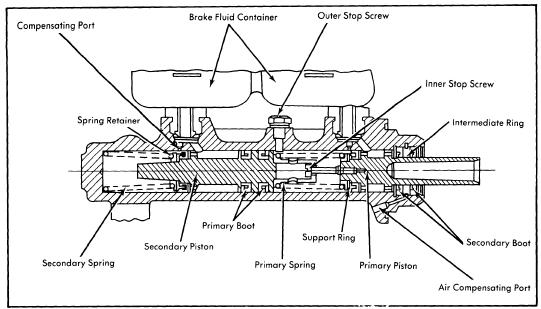
Disassembly - Thoroughly clean outside of master cylinder. Remove hydraulic fluid reservoir, remove retaining ring, and remove primary piston assembly. Loosen or remove (if necessary) piston stop screw and remove secondary piston assembly. Disassemble primary and secondary piston assemblies.
Cleaning & Inspection - Clean all parts in alcohol only. Dry all parts with compressed air and check that compensating parts of cylinder are free of obstructions. Check cylinder bore and pistons for rust, corrosion or other damage. Inspect cylinder bore and pinion for wear. Maximum allowable cylinder diameter is .817:; minimum allowable piston diameter is .807". Manufacturer recommends replacing all rubber parts whenever cylinder has been disassembled.
Reassembly - Reverse disassembly procedure and note the following: Do not apply grease to push rod as damage may result to rubber components.
POWER BRAKE UNIT
NOTE - Manufacturer does not recommend overhaul of power brake unit.
Fig. 5 Sectional View of Audi 100LS Tandem Master Cylinder


Audi S90 & 100 1970-73 Brake Repair Guide

Models Covered
  • S90 (1970-72)
  • 100 (1970-73)


DESCRIPTION
Brake system is hydraulically operated, utilizing a tandem master cylinder and Teves T 51/349 power brake unit. Front disc brakes consist of rotors attached to transmission output flanges, and two-piston calipers attached to transmission. Disc pads are equipped with a ceramic transmitter-type wear sensor. Transmitter is mounted on cross spring and will break when contact is made with pad plates, interrupting control circuit and causing indicator light on instrument panel to be activate. Rear brakes are leading-trailing shoe/drum type, using a dual piston wheel cylinder. Parking brake is cable actuated, operating secondary shoes of rear brake assemblies.
ADJUSTMENT
NOTE - Adjustments or readjustments should be carrier out on cold brakes. However, brakes must be warm when testing. Instrument panel trim must be removed to adjust master cylinder push rod free play.
MASTER CYLINDER PUSH ROD FREE PLAY
Check brake pedal free play by measuring distance between master cylinder push rod and master cylinder piston. This measurement should be .039" (1.0 mm), which would give free play of .20" (5.08 mm) at brake pedal. If necessary to adjust, loosen lock nut on push rod and turn push rod until correct clearance is obtained. Tighten lock nut and again measure pedal free play at brake pedal.
FRONT DISC BRAKES
Front disc brakes are self-adjusting, therefore, no adjustment in service is required.
REAR DRUM BRAKES
Raise and support rear of vehicle release parking brake. Using a 17 mm wrench, tighten eccentric adjusters until wheels can no longer be turned by hand. Loosen eccentric adjusters until wheels are just free to turn.
PARKING BRAKE
Raise and support rear of vehicle and adjust rear brakes. Lift parking brake lever until it engages third ratchet stop. Adjust nut at equalizer until rear wheels are just free to turn. When parking brake lever is pulled up one additional notch (to fourth ratchet stop), rear wheels should be locked.
HYDRAULIC SYSTEM BLEEDING
Fill master cylinder reservoir with brake fluid and maintain level throughout bleeding operation. Attach a hose to bleeder screw, and immerse opposite end in a container partially full of brake fluid. Open bleeder screw approximately one-half turn, depress brake pedal, close bleeder screw, and slowly return pedal. Continu operation until air bubbles are no longer seen in discharge fluid. Bleeding sequence is left-rear, right-rear, right-front, left-front.
REMOVAL & INSTALLATION
FRONT DISC BRAKE PADS
Removal - Remove lock clips. Pull out retaining pins so they project into openings in side members. NOTE - Do not remove rubber grommets from side member holes. Using a suitable extractor tool (SB-3), remove disc pads from caliper.
NOTE - Disc pads can be removed on right side only after removing front exhaust pipe.
Installation - Press both pistons into caliper bores.
NOTE - Fluid level in master cylinder reservoir will rise.
Siphon sufficient fluid to prevent reservoir from overflowing. Ensure pistons are in correct alignment in bores using suitable tool (B-5). Install disc pads in recesses of caliper, slide in retaining pins, and install lock clip. Pump brake pedal several times to position disc pads. Bleed hydraulic system if necessary.
FRONT DISC BRAKE CALIPER & ROTOR
Removal - 1) On vehicles equipped with automatic transmission, disconnect steering damper from its bracket and move out of way. On all models, depress brake pedal approximately 1.2" (30.48 mm) and hold in this position by using suitable pedal support. Disconnect temperature transmitter wire from connector (near transmission)
2) On automatic transmission equipped vehicles, disconnect hydraulic line at union on transmission, EGR line at exhaust pipe, and exhaust pipe from hangers. On all models, disconnect and remove front exhaust pipe and shield from manifold, and drive shaft at stub axle.
3) Remove ball joint mounting bolts, pull wheel downward, and swing out steering knuckle after prying it off ball joint. Remove disc brake pads, leaving spring and wire in vehicle. Remove EGR filter from oil  pan. Remove caliper mounting nuts, then remove caliper and rotor from stub axle. NOTE - If necessary, pry engine assembly to one side to ease removal.
Installation - To install, reverse removal procedure, tighten caliper mounting bolts securely, and bleed hydraulic system.
REAR BRAKE DRUM
REAR BRAKE ASSEMBLY
Removal - Raise and support vehicle, remove wheel and tire assembly. Pry off dust cap, remove cotter pin from hex nut, and remove nut. Remove brake drum making sure that retaining washer and wheel bearing do not fall out.
Installation - To install, reverse removal procedure adjust brakes, and adjust wheel bearings. See Wheel Bearing Adjustment in WHEEL ALIGNMENT Section.
REAR BRAKE SHOES
Removal - With brake drum removed, remove retaining spring for brake shoes. Remove shoes as an assembly by disconnecting spring at bottom, pulling shoes back from wheel cylinder, and disconnecting parking brake cable.
Installation - To install, reverse removal procedure and not the following: Make sure long ends of retainin clip and spring are installed on secondary shoe and parking brake lever. Ensure brake shoes are correctly positioned on wheel cylinder pistons.
REAR BRAKE WHEEL CYLINDER
Removal - With drum and shoes removed, depress brake pedal approximately 1.4" (35.56 mm) and hold in this position by using suitable pedal support. Disconnect remaining hydraulic line and cylinder mounting nuts. Separate master cylinder from power unit, taking care not to lose "O" ring installed between units.
Installation - To install, reverse removal procedure, adjust brakes and bleed hydraulic system.
MASTER CYLINDER
Removal - Disconnect hydraulic line at rear of master cylinder. Depress brake pedal 1.2-1.6" and hold in position using a suitable pedal support. Disconnect remaining hydraulic line and cylinder mounting nuts. Separate master cylinder from power unit taking care not to lose "O" ring installed between them.
Installation - To install, reverse removal procedure and bleed hydraulic system.
POWER BRAKE UNIT
Removal - Siphon brake fluid from master cylinder reservoir and disconnect hydraulic lines. Loosen hose clamp and disconnect vacuum hose from power unit. From inside vehicle, remove trim below instrument panel as necessary. Disconnect push rod form brake pedal, remove power unit adapter attaching nuts, and remove power unit and master cylinder from engine compartment as an assembly. Separate master cylinder and adaptor from power unit.
Installation - To install, reverse removal procedure and note the following: Be sure to install "O" ring between master cylinder and power unit. Install adaptor to power unit so that center punch mark on adaptor is located on lower right hand side facing engine. To complete installation, adjust pedal push rod free play and bleed hydraulic system.
Check Valve Replacement - A vacuum check valve is locate in vacuum line between intake manifold and power it. To remove, loosen hose clamps, separate vacuum hoses from check valve, and remove check valve. To install, reverse removal procedure and not the following: Check valve is stamped with the word "MOTOR" and an arrow. End of valve in which arrow points must be connect to shorter hose from intake manifold.
OVERHAUL
FRONT DISC BRAKE CALIPER
FRONT DISC BRAKE CALIPER ASSEMBLY
Disassembly - Remove disc pads. Pry out retaining ring and remove dust seal by hand. Place a small block of wood in caliper cavity, and remove piston by applying compressed air to fluid inlet. Remove remaining piston in same manner. Remove seal from caliper bore using a piece of wood or plastic. NOTE - Do not use hard or sharp tools for this purpose. Do not separate caliper halves.
FRONT DISC BRAKE CALIPER ASSEMBLY
Cleaning & Inspection - Clean all parts in alcohol only. Check cylinder bore and piston for damage. NOTE - Do not machine caliper bore or piston. Parts are serviced by replacement only.
PINION INSTALLATION
Reassembly - Coat all parts with ATE brake cylinder paste (or equivalent), reverse  disassembly procedure, and note the following: Use new seals, dust boots, and retaining rings when reassembling. When installing piston, make sure machined surface of piston face makes a 20° angle to wall of caliper bore (see illustration). Install disc pads after caliper has been installed on vehicle.
REAR WHEEL CYLINDER
Disassembly - Thoroughly clean outside of cylinder. Remove end caps, piston and seal assemblies, and spring. Remove dust cap and bleeder screw.
AUDI MASTER CYLINDER
(COMPONENT PARTS)
Cleaning & Inspection - Clean all parts in alcohol only. Check all parts for rust, corrosion, and damage. Check cylinder bore and piston for wear or damage. Cylinder bore should not exceed .6287" (16.00 mm) and piston diameter should not be less than .619" (15.74 mm). NOTE - Manufacturer recommends replacing rubber components on each disassembly.
Reassembly - Reverse disassembly procedure and not the following: Apply a thin coat of ATE brake cylinder paste (or equivalent) to all parts during assembly.
MASTER CYLINDER
Disassembly - Remove reservoir, brake light switch, circlip and dismantle cylinder. To extract piston, unscrew stop screw.
Cleaning & Inspecting - Clean all parts in denatured alcohol. Inspect bore and piston for rust or wear and replace any parts out of tolerance. It is advisable to always replace rubber parts.
Reassembly - Preassemble pistons and coat cups with ATE brake cylinder paste (or equivalent). Insert assembly into cylinder bore, install stop screw and circlip. Install brake light switch and resrevoir.
NOTE - Models without power brake servo differ slightly. Primary piston desgin is somewhat varied. Piston is equipped with only on secondary boot. There is no air compensating bore. Brake light switch location is different.


Audi Fox 1973-77 Brake Repair Guide

DESCRIPTION
Brake system is hydraulically operated, utilizing a tandem master cylinder and a Teves power brake unit. Front disc brakes consist of rotors attached to wheel hubs, and single piston floating caliper assemblies attached to steering knuckles. The disc brake pads are equipped with wear indicators that create a pulsation in the brake pedal when the pads are worn. Rear brakes are leading trailing shoe/drum type, using a dual piston wheel cylinder. Parking brake cable actuated, operating secondary shoes of rear brake assemblies. Pressure regulator valves for rear wheels mount to power brake unit.
ADJUSTMENT
FRONT DISC BRAKE PADS
Front disc brakes are self-adjusting, therefore, no adjustment in service is required.
REAR DRUM BRAKE SHOES
Raise and support rear of vehicle, release parking brake. Use a brake spoon, tighten rear star adjuster until wheel can no longer be turned by hand. Loosen star until wheels are just free to turn.
PARKING BRAKE
With rear brake shoes properly adjusted, pull parking brake handle to second notch. Tighten parking brake adjusting nut rear wheels can just be turned by hand, then tighten lock nut. Release handle and ensure both rear wheels rotate freely.
PRESSURE REGULATOR VALVE
Operation Test - Place hand around pressure regulator. Depress brake pedal relatively hard. Release pedal; listen and feel for a slight "knock" in each regulator. This is the piston returning in regulator.
Pressure Test - 1) Use two pressure gauges that will record at least 1400 psi. Hook one gauge to left rear wheel cylinder. Attach other gauge to right front caliper cylinder. Bleed both hoses through bleeder gauges. Operate pedal vigorously several times.
2) Depress brake pedal until gauge on right front caliper reads 497 psi at the same time the gauge hooked to the left rear wheel cylinder should read 384 psi.
3) Continue depressing pedal and hold it in position when right front gauge reads 1400 psi, left rear wheel cylinder gauge should read between 768-862 psi. Repeat procedure to check other side. Replace any regulator that does not meet specifications outlined here.
HYDRAULIC SYSTEM BLEEDING
Fill master cylinder reservoir with brake fluid and maintain level throughout bleeding operation. Attach a hose to bleeder screw, and immerse end in a container partially full of brake fluid. Open bleeder screw approximately one-half turn, depress brake pedal, close bleeder screw, and slowly return pedal. Continue operation until air bubbles are no longer seen discharged fluid. Bleeding sequence is right-rear, left-rear, right-front, left-front.
REMOVAL & INSTALLATION
FRONT DISC BRAKE PADS
Removal - Raise and support front of vehicle and remove wheel and tire assembly. Pull spring locks out of retaining pins, drive retaining pins out toward outside of vehicle, and remove cross spring. Use a suitable tool (P 86), remove inboard brake pad. Pull mounting frame and brake cylinder outwards until outboard pad can be removed
Installation - Press piston to bottom of travel in cylinder and floating frame. NOTE - Level in master cylinder reservoir will rise. Siphon off sufficient fluid to prevent overflowing. Ensure machined portion of piston face makes a 20° angle to lower caliper wall. Install disc pads by reversing removal procedure.
FRONT DISC BRAKE CALIPER
Removal - With wheel and tire assembly and disc brake pads removed, disconnect hydraulic line from caliper. Remove bolts securing caliper to steering knuckle and remove caliper.
Installation - Reverse removal procedure and  bleed hydraulic system.
FRONT DISC BRAKE ROTOR
Removal - With wheel and tire assembly removed, remove caliper. NOTE - Do not disconnect hydraulic line unless necessary. Remove screw securing rotor to wheel hub and withdraw rotor.
Installation - Reverse removal procedure and bleed hydraulic system if necessary.
REAR BRAKE DRUM
Removal - Pry off grease cap. Remove cotter pin, castle nut, hex nut, and washer. Pull off brake drum making sure that inner race of outer bearing is not lost.
REAR BRAKE SHOES
Fig. 1 Exploded View of Rear Brake Assembly
Removal - With brake drum removed, disconnect lower spring by removing from primary shoe. Remove shoe vibration cups, springs, and pins. Remove primary shoe from backing plate, disconnect parking brake cable from lever, and remove secondary shoe and parking brake lever assembly.
Installation - Reverse removal procedure and not the following: Before installing secondary brake shoe, make sure that rear wheel cylinder piston is positioned so that web face outward and opening inward. Ajust brakes and bleed hydraulic system if necessary.
REAR BRAKE WHEEL CYLINDER
Removal - Depress brake pedal approximately 1.2" to close compensator bore in master cylinder, and hold in position using a suitable pedal support. Disconnect hydraulic line from cylinder and plug with rubber cap from bleeder screw. Remove bolts attaching wheel cylinder to backing plate. Remove cylinder by maneuvering out of backing plate
Installation - Reverse removal procedure and not the following: Make sure that rear piston is installed in wheel cylinder so that web faces outward and opening inward. Bleed hydraulic system.
Fig. 2 Audi Fox Disc Brake Caliper Assembly
MASTER CYLINDER
Removal - Siphon brake fluid from master cylinder reservoir. Disconnect hydraulic lines at cylinder, remove nuts attaching master cylinder to power unit, and remove master cylinder.
Installation - Reverse removal procedure and not the following: Make sure "O" ring is installed between master cylinder and power unit. After installing master cylinder, bleed hydraulic system.
OVERHAUL
FRONT DISC BRAKE CALIPER
Disassembly - Remove disc pads and pry mounting frame and piston assembly off floating frame. Remove brake cylinder and guide spring from floating frame. Remove clamp and dust cap from brake cylinder, then withdraw piston. NOTE -If necessary, apply compressed are to fluid inlet. Remove seal from cylinder.
Cleaning & Inspection - Thoroughly clean all parts in alcohol. Check all parts for rust, corrosion, or other damage; replace parts as necessary. NOTE - Manufacturer recommends replacing rubber parts whenever caliper has been disassembled.
Reassembly - Apply a thin coat of ATE brake cylinder paste (or equivalent) to cylinder, piston and seal, and reassemble. Place guide spring in groove of brake cylinder, then drive cylinder on floating frame with a brass mandrel. Place mounting frame in guide spring, then slide it on floating frame.
REAR BRAKE WHEEL CYLINDER
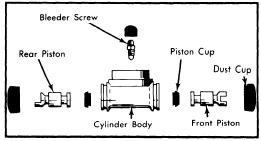
Fig. 3 Exploded View of Rear Wheel Cylinder
Disassembly - Remove rubber dust caps, then withdraw front and rear piston and seal assemblies. Remove seals from pistons. Remove bleeder screw and dust cap.
Cleaning & Inspection - Thoroughly clean all components in alcohol. Inspect cylinder and pistons for rust, corrosion, or scoring; replace parts as necessary. NOTE - Manufacturer recommends replacing all rubber parts whenever cylinder has been disassembled.
Reassembly - Reverse disassembly procedure and note the following: Pistons are not interchangeable. Install notched piston in front of cylinder so that it will engage primary shoe when installed on backing plate.  
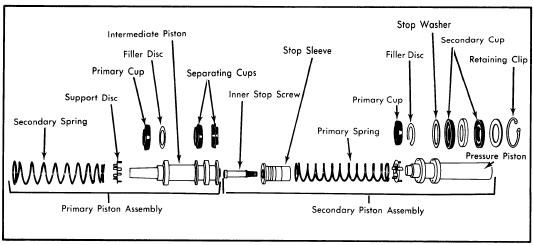
Fig. 4 Master Cylinder Pinion Assembly

MASTER CYLINDER
Disassembly - Remove "O" ring from master cylinder housing. Remove retaining ring and loosen piston stop screw, then remove both pistons from housing. Remove pressure valves and reservoir from master cylinder housing. Disassemble piston assemblies as necessary.
Cleaning & Inspection - Clean all parts in alcohol and check for rust, corrosion, or other damage; replace parts as necessary. Make sure compensating and filler holes are not plugged.
Reassembly - Reverse disassembly procedure and note the following: Make sure pressure and intermediate piston cups are installed correctly. See Fig. 4. Use new "O" ring on master cylinder between cylinder and power unit. 
POWER BRAKE UNIT
NOTE - No information available for Overhaul of power brake unit.


Import Wheel Bearing Adjustment 1974


ALFA ROMEO
All Models - While Rotating hub, tighten spindle nut to 18 ft. lbs. Loosen nut, then retighten to 7 ft. lbs. Back off on nut 1/4 turn and install cotter key. If slot in spindle nut does not align with hole in spindle, tighten nut until it is possible to insert cotter key. After cotter key is installed, ensure that bearing retainer plate can be easily rotated by inserting a screwdriver in plate holes

AUDI
NOTE - The following procedure can only be perofrmed using special tools indicated

Model 100 (Front) - 1) Raise and support front of vehicle. Remove lower wheel bolt and replace with special wheel bolt adapter (V-104) and special dial indicator (G-43). By means of retaining screw on special tool (V-104), adjust dial indicator to pretensioned position of 1 milimeter.

2) Grasp wheel at front and rear. First push inward on front while pulling outward on rear, record dial indicator reading. Reverse this procedure and record dial indicator reading. Difference between these two readings is wheel bearing play. If play exceeds .04-.07 mm, adjustment will be necessary

3) Remove cotter pin and castle nut. If there was too much play, tighten spindle nut until play is within specifications. If there was insufficient play, remove wheel, spindle nut and its shim. Replace and tighten spindle nut. Using 1 millimeter feeler gauge, loosen spindle nut until it is possible to insert feeler gauge between spindle nut and wheel hub. Attach special hub puller (V-26) and withdraw hub until it is firmly in contact with spindle nut. Remove puller and retighten spindle nut until it is within specifications.

Model 100 (Rear) - Raise and support rear of vehicle. Remove grease cup and one wheel bolt. Attach special dial indicator (30-43), using wheel bolt adapter (40-104) and attachment (10-22). Dial indicator actuator foot should be pretensioned to 1 millimeter agains the stub axle. Grasp wheel at front and rear. Move wheel on horizontal axis. If reading on dial indicator is not .02-.04 mm, adjustment will be necessary. Adjust by loosening or tightening spindle nut.

NOTE - Fox front wheel bearing is not adjustable. Torque stub axle nut to 13 ft. lbs.

Fox (Rear) - Remove grease cup, cotter pin and castle nut. Tighten spindle nut and loosen for adjustment. Adjust by lightly tightening spindle nut until plain washer (beneath spindle nut) can just be moved from side to side, using screwdriver. This adjustment will correspond to .0012-.0027" (.03-.06mm) wheel bearing play.

AUSTIN

Austin Marina - Raise and support vehicle so that front wheel is not touching ground. Remove grease cup and attach suitable magnetic base dial indicator with base on brake drum and actuating foot touching spindle. Bearing wobble should be from .001-.005". If adjustment is required, remove cotter pin and slacken castle nut. Torque castle nut, and retighten castle nut, finger tight only. Reinstall cotter pin. NOTE - At minimum end-float figure given, a considerable amount of movement will be felt in the front wheel. Do not reduce end-float below .001".

BMW

All Models - While rotating hub, tighten castle nut to 7 ft. lbs., then back off on nut 1/3 turn. Insert screwdriver in recess of bearing retainer washer and ensure washer can be rotated easily. Install suitable gauge holder (BMW 5104) on wheel hub and install dial indicator with tip touching front axle stub. Shake wheel hub and read dial indicator for bearing play. Adjust castle nut until bearing play is .0008-.0024". 
NOTE - Set bearing play as close to lowest limit as possible. Install cotter key>

CAPRI

All Models - Rotate wheel, hub, and drum assembly while turning adjusting nut to 17-25 ft lbs. Back off nut one-half turn. Retighten adjusting nut to 10-15 INCH lbs. Reinstall cotter pin and check front wheel rotation.

COLT
All Models - Tighten adjusting nut to 14.5 ft. lbs. After seating bearing components, loosen nut to 0 ft. lbs. Now make final adjustment to 3.6 ft. lbs. After installing lock cap, insert cotter pin. NOTE - Do not loosen adjusting nut more than 15 degrees to align spindle holes

COURIER
All Models - While rotating wheel, hub and drum assembly tighten adjusting nut to 17-25 ft lbs. Back Adjusting nut off 1/2 turn and retighten nut to 6-8 ft. lbs. Install new cotter key and check wheel rotation

DATSUN
All Models - Tighten spindle nut to torque specification in following table. Spin wheel and retorque spindle nut. Loosen nut according to specifications in following table and then tighten to align cotter key hole. Insert cotter pin.

Wheel Bearing Adjustment
Application                                            Torque (Ft. Lbs.)                                  Loosen
B210.........................................................22-25..................................................90*
Pickup.......................................................22-25...............................................40-70*
All Other....................................................18-22..................................................60*

FIAT
Model 124 - While rotating hub, torque spindle nut to 14.5 ft. lbs. Completely loosen nut and retighten to 5 ft. lbs. Loosen nut 30 Degrees and stake collar of spindle nut into machined slot on spindle. Attach a dial indicator with magnetic base on brake drum and actuating foot on spindle. Hub end play should not exceed .039". NOTE - When ever spindle nut has been removed it must be replaced with a new nut.

Models 128 & X1/9 - Tighten front and rear spindle nuts to 112 ft. lbs. When spindle nuts are properly tightened, stake collar of spindle nut into machined slot on spindle.


Older Post ►
eXTReMe Tracker
 

Copyright 2011 Car Repair Man is proudly powered by blogger.com